Archive for the ‘kh6wz’ Tag
I came across this sculpture while doing some research on mechanical sculptures. The video is a bit long, but the creations look like a good way to use a bunch of surplus motors. . . They make a noise that sounds like falling rain or a racquetball court – or – something.
>>>> Click here to see the works made by the artist called Zimoun
Freightliner website shouts:
Think it can’t be done?
THINK AGAIN.
Freightliner Trucks drove a Cascadia 113 day cab tractor powered by CNG from LA to DC…
>>> Click here to see a video about this CNG-fueled cross country trip
It’s been a long time since I posted an update on the Factory Five Racing Coupe. Here is an update in pictures and captions . . .
-
-
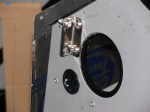
Type 65 Coupe complete kit brake reservoir bracket location
-
-
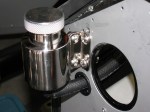
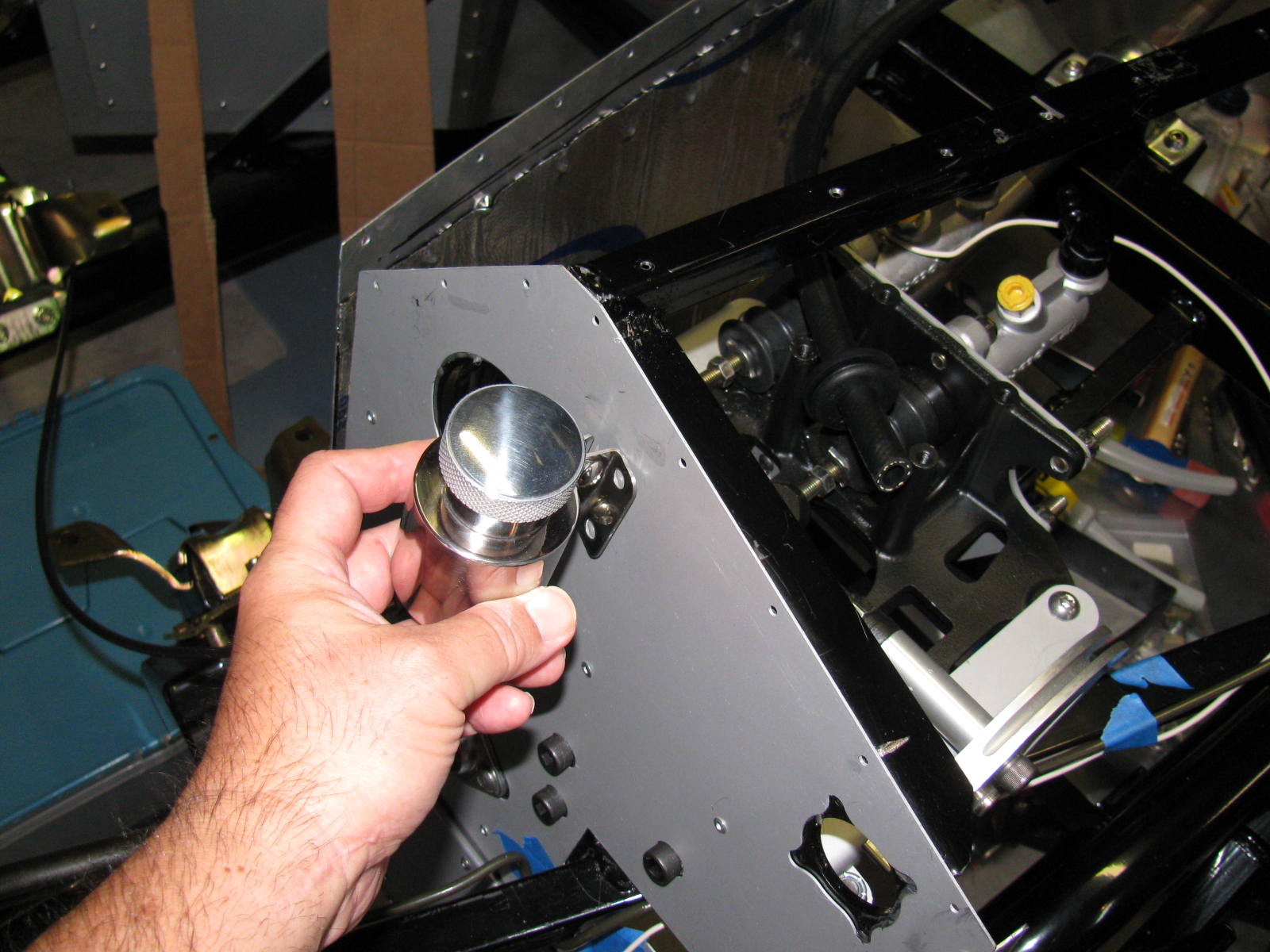
Polished stainless steel brake reservoir can, Type 65 Coupe, Complete Kit
-

-
I added a plastic grommet from the hardware store electrical section to prevent chafing the brake fluid hose.
-
-
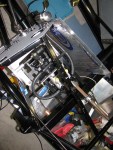
I followed the hose layout as shown in the current Roadster build manual.
-
-
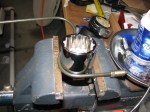
I used a big socket (35mm, I think) in a bench vise to bend my brake lines. Nothing fancy.
-

-
Brake lines are bent into rough shape, then taped in place along its route. Final bending is done on the chassis by hand.
-

-
Brake line held in place with tape, More adjustments are done by hand. Notice the way the excess lines are curved – this allows flexing in two planes – up and down and left and right. This is a 40-inch, pre-flared line I bought at a local car parts store. The supplied 60-inch line was way too long.
-

-
I start my brake line layout by marking the center of the span. This is the large rectangular tube going across the rear. The white wire (number 12 solid copper house wire) is used to make an extremely rough approximation of how the line will run.
-

-
Here you can see the white wire mock-up next to the steel brake line. The roughly Ohmega shape is centered above the IRS pumpkin.
-

-
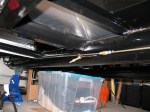
I decided to run the rear brake line on the inside of the firewall. It will look cleaner in the engine bay and will help keep the line cooler.
-
-
I got lucky. I used a 60-inch line from the rear master cylinder, down the inside of the firewall, and ended up under the driver seat area. A second 60-inch line goes from the union to the rear brake tee. No custom length needed.
-
-
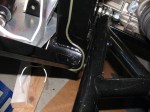
Here’s how the line goes up the support next to the lower rear sway arm. It will be slightly bent away from the chassis and held in place with the insulated line clips to prevent chafing.
-

-
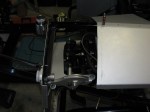
Going up to meet the rear brake flex line, driver’s side.
-
-
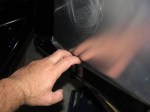
A peek into the pedal box – I am still not quite sure how this is going to work. The sheet metal on the right is going to be covered by the Coupe body, so this will be riveted – or screwed – into place. The open side on the left is going to have a one-piece cover. Will this provide enough access for brake balance and clutch cable adjustments?
-

-
Inside the pedal box, showing the front brake line going to the master cylinder. Not as pretty as some others I have seen, but I can always re-do this later, right?
-
-
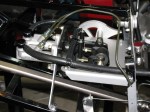
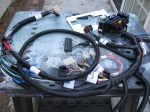
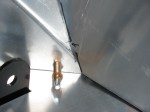
Here is a view of the rear brake line going to the second master cylinder. I drilled out one rivet fastening the sheet aluminum to the firewall and replaced it with an 8-32 stainless steel screw. It holds the line clip as well as the firewall panel.
-
-
Next on the to-do list: Wiring
-

-
Next on the to-do list: Fuel tank.
It has been very hot in the garage over the last several weeks, temperatures in the garage were about 95 degrees F (35 degrees C) – I finally did a functional test of my portable air conditioner. This is not a new idea, I saw this several years ago on some maker/hacker site, and there is a commercial version of something very similar to this sold at recreational vehicle and camping stores.
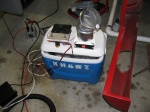
Basically, it is an ice chest filled with ice water, some 12VDC fans, an automotive heater core, a marine bilge pump and some hose. Ice water circulates through the heater core while one fan blows air into the cooler and another fan blows air out of the cooler.
I need to cut a notch in the cooler to make way for a bracket, but it is otherwise complete.
This thing made me think about making a water-cooled vest, using a smaller pump and my back-mounted water carrier – it would be perfect for events like Burning Man and ROCstock!
-
-
The KH6WZ Air Cooler under its first test. Ambient temperature was 95 degrees. The cover does not fully close because of some mounting bracket interference. This will be corrected and more tests will be run.
-
-
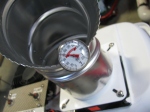
Fan only running, with ice. A drop of almost 10 degrees.
-
-
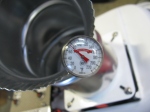
With fan and pump running, an additional 3 to 4 degree reduction. I think the effectiveness will improve if the container is fully sealed and more ice is added.
Some friends at the office launched a helium balloon last weekend (Sunday 25 August). We talked about tracking the balloon and of course, I have several ham radio “tracker boxes” that interface a GPS unit to ham radio and then the Internet. Making something small and lightweight could be something that can be part of the payload for a high altitude balloon.
Interestingly, I had a project in my mind ever since I started my various beacon projects many years ago: It is a 21st century message in a bottle – build a disposable, waterproof, floating APRS beacon that I can throw overboard and into the ocean. Then the world can track this thing as it floats around. It will have some instructions on what to do with it if it is found. And, if the finder is or knows a ham radio operator, I will ask that they throw it back into the ocean so it can be found and tracked again.
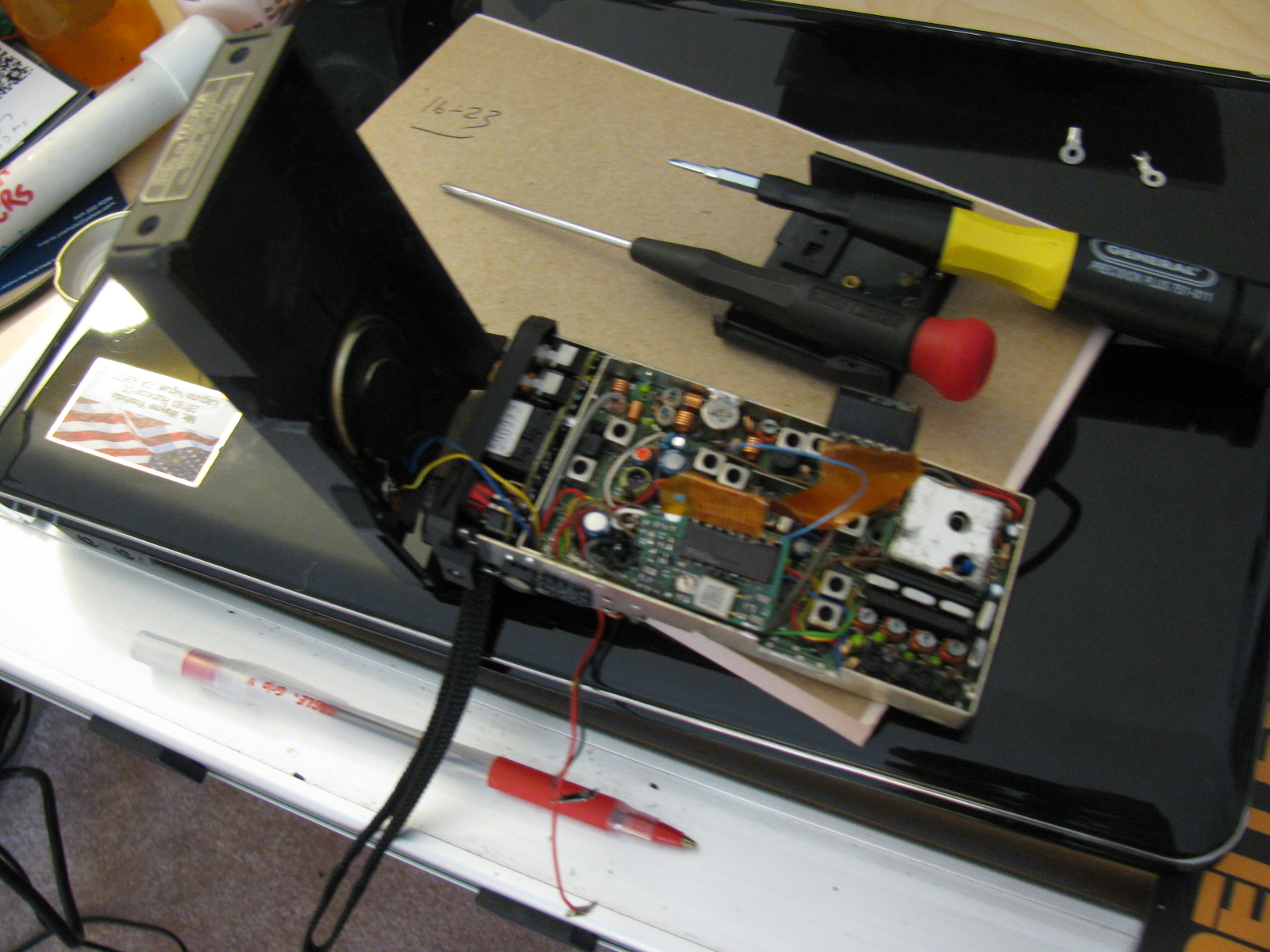
Here is a picture of one of the main ingredients I will be using:
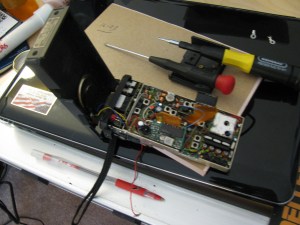
An old but working 2 meter HT can be put to good use as the RF portion of an APRS beacon.
The plastic case, battery pack and rubber duckie antenna will be discarded to reduce weight. LED indicator lights will be disconnected to reduce current consumption. Other parts or functions will be deleted to conserve space, weight and power consumption.
The APRS modem will be a TinyTrak unit, as with my other APRS projects.
I may build two of these, one for balloon flights and one for message in a bottle use.
Discovery Science Center – Advanced Ham Radio on Display at the Meet the Makers Event

Signage at The Discovery Cube announces the Meet the Makers Event
Dennis Kidder (W6DQ), Walter Clark and I demonstrated our Maker Faire ham radio projects at the Discovery Cube in Santa Ana on June 29 and 30, 2013. We used my TinyTrak APRS beacon to indicate our location during the event. In case the plot is removed or expires, here is an image of the map showing our location. KH6WZ is indicated by the eye icon near the Interstate 5 freeway in Santa Ana.

This is a screen capture showing the KH6WZ APRS beacon data from the Discovery Science Center – Meet the Makers event.
This was a great opportunity to expose people to today’s technology Amateur Radio, and continued along my Maker Faire theme, “Not Your Grandpa’s Ham Radio.”
Dennis brought his dual band 10 GHz and 24 GHz transverter, controlled and interfaced to his software-defined radio (SDR).
Walt brought his polarization demonstration units, which helped people visualize how radio signals propagate and change as they travel through the air. Here’s how Walt explains his demos:
Two demonstrations show the structure of radio waves – in this case microwaves.
One
The structure of a radio wave in angle around the direction of travel: This is called polarization. A spinning bargraph that has a receiving antenna that also spins will reveal the way radio waves “look” to a receiving antenna. The lesson here is that the receiving and transmitting antennas have to be oriented to the same angle.
Two
The structure of a radio wave along the direction of travel: When a receiver is arranged to look exactly in [or along] the direction the radio waves are going out, reflections can be measured; just like in radar. The reflection off of the hand or the chest of a person causes the speaker to be loud or quiet depending on the exact position. It cycles from loud to quiet every 1.5 cm whether inches or many feet away. The lesson here is that with this equipment, you can picture in your mind the wavelength and especially note that the wavelength is the same no matter how far the radio wave travels.
We did not establish any goals for this event, but there were several memorable visitors to our little table display, including teachers, Maker Faire participants, some current and ex-ham radio operators, many engineers and retired engineers as well as engineering students.
This “Meet the Makers” event was a double treat for me, since this was the first time I visited the Science Center, and I had a blast talking about the new technologies being used by today’s ham radio enthusiasts.
Here are some pictures of this event . . .
-

-
An R/C R2D2 makes an appearance at the Meet the Makers event at the Discovery Science Center.
-

-
The 24-inch dish antenna makes a great stand for signage.
-

-
The KH6WZ APRS beacon display at the Meet the Makers event.
-

-
Dennis W6DQ, brought his software defined radio with 10 GHz and 24 GHz transverter to our exhibit.
-

-
Walt brought several fascinating displays to illustrate radio wave propagation.
-
-
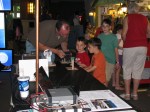
Dennis explaining the radio wave demonstration to our target audience: kids.
-

-
Great shot of Walt explaining radio wave propagation to some visitors.
-

-
The Science of Hockey at the Discovery Science Center
-
-
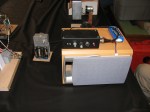
A close-up of one of Walt’s displays
Acknowledgements
Thanks to Bequi Howarth, of the Orange County Mini Maker Faire, who introduced us to the Discovery Science Center.
Links to More Information
Byonics (TinyTrak APRS and Weather Units)
Discovery Science Center, Santa Ana, CA
Orange County Mini Maker Faire, University of California, Irvine (UCI)
Maker Faire
Make: Magazine
American Radio Relay League (ARRL)
CQ Magazine
San Bernardino Microwave Society (SBMS)
Wayne Yoshida LinkedIn Profile
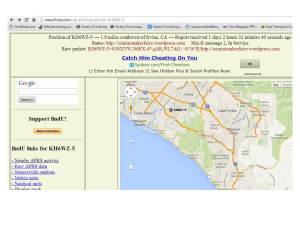
APRS display of the KH6WZ-5 location beacon at the 2013 OC Mini Maker Faire at UCI. Notice the beacon message at the top of the screen capture includes the URL of the event – a great publicity tool!
This past weekend, the second OC Mini Maker Faire happened. And it just so happens to be the second running of my ham radio demonstration called, “Not Your Grandpa’s Ham Radio (2)!” This is my continuing mission to remind people of two things:
First, “The Maker Movement” is nothing new, Amateur Radio operators have been doing this for a almost a century, and nearly 2 million people worldwide are involved in ham radio in some way.
Second, Ham radio is not necessarily an old man’s hobby where weird guys talk to strangers from garages and basements. We are skilled wireless communicators and use today’s technology, from GPS and microprocessors to lasers and microwave frequency linking.
This time I added static and working displays of my various APRS beacons (KH6WZ, KH6WZ-5, and others). I programmed the OC Mini Maker Faire’s URL to the beacon message so people can take a look at what was happening – an excellent publicity tool!
I also planned on making some 10 GHz contacts with my rig, since this was also the same weekend as the ARRL 10 GHz and Up Contest. The transverter covers were removed so people can see the system’s guts.
Based on previous experience at the Discovery Science Center “Meet the Makers” event, I demonstrated radio wave polarization- horizontal vs vertical – with my rig and the microwave strength meter.
Since I had plenty of space, I shared my booth with a company that makes interesting computer and microprocessor related items. This may sound trivial, until you realize this company is run by these three young guys . . .
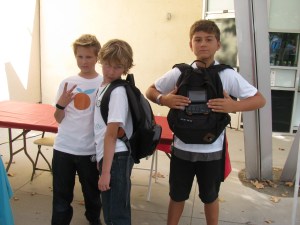
Huxley, Max and Ethan showing one of their products called the SmartPac.
There seemed to be more people at this Faire, probably since not too many other events were happening nearby. The 405/605/22 freeway closure did not affect the MF, since it started after the event ended.
More than a dozen hams – either active or at least licensed – stopped by to visit. We talked about this event as well as the Bay Area Maker Faire, and what ham radio activities we are involved with.
One more thing: I met several guys from the San Diego area – they are finalizing the plans to have a Mini Maker Faire in the San Diego area – this is great news. Stay tuned and I will announce an update as soon as I hear something from the committee!
Here are some pictures from the event. I am already thinking of building some new displays for next year.
-
-
The 24-inch M/A-COM dish with the KH6WZ logo makes a pretty decent sign for the booth, eh?
-

-
The KH6WZ 10 GHz transmitter-receiver unit on display at the Orange County Mini Maker Faire on the UCI campus
-

-
KH6WZ horn antenna and microwave field strength meter at the OC Mini Maker Faire 2013
-

-
The KH6WZ APRS beacon (unit 1) at the OC Mini Maker Faire 2013. This was a static display unit to show components and construction.
-
-
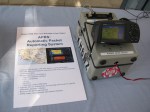
KH6WZ-5 APRS beacon – active and sending position data at the 2013 OC Mini Maker Faire at UCI. The beacon message included the Faire’s URL.
-

-
This familiar unit makes an appearance at the Maker Faire. . .
-

-
The robot “Titan” was a crowd pleaser – it throws flying discs and comes to you for a refill.
-

-
Track Roamer robot at the OC Mini Maker Faire. Notice the Nerf gun. When you come to next year’s event, remember to wear a red shirt.
-
-
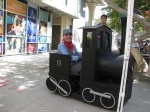
One of the “roving displays” at the OC Mini Maker Faire 2013.
-
-
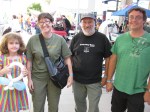
Some ham visitors at the Orange County Mini Maker Faire 2013: Haliey, Michelle W5NYV, Paul KB5MU and John KJ6HZ.
-

-
Michelle W5NYV wearing her daughter’s alpha wave ears. The ears move and react to pulses from a sensor clipped to her left ear.
-
-
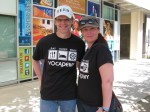
An unknown couple wearing Vocademy shirts. What a great slogan: Eat, Sleep, Make.








 wayneyoshidakh6wz